
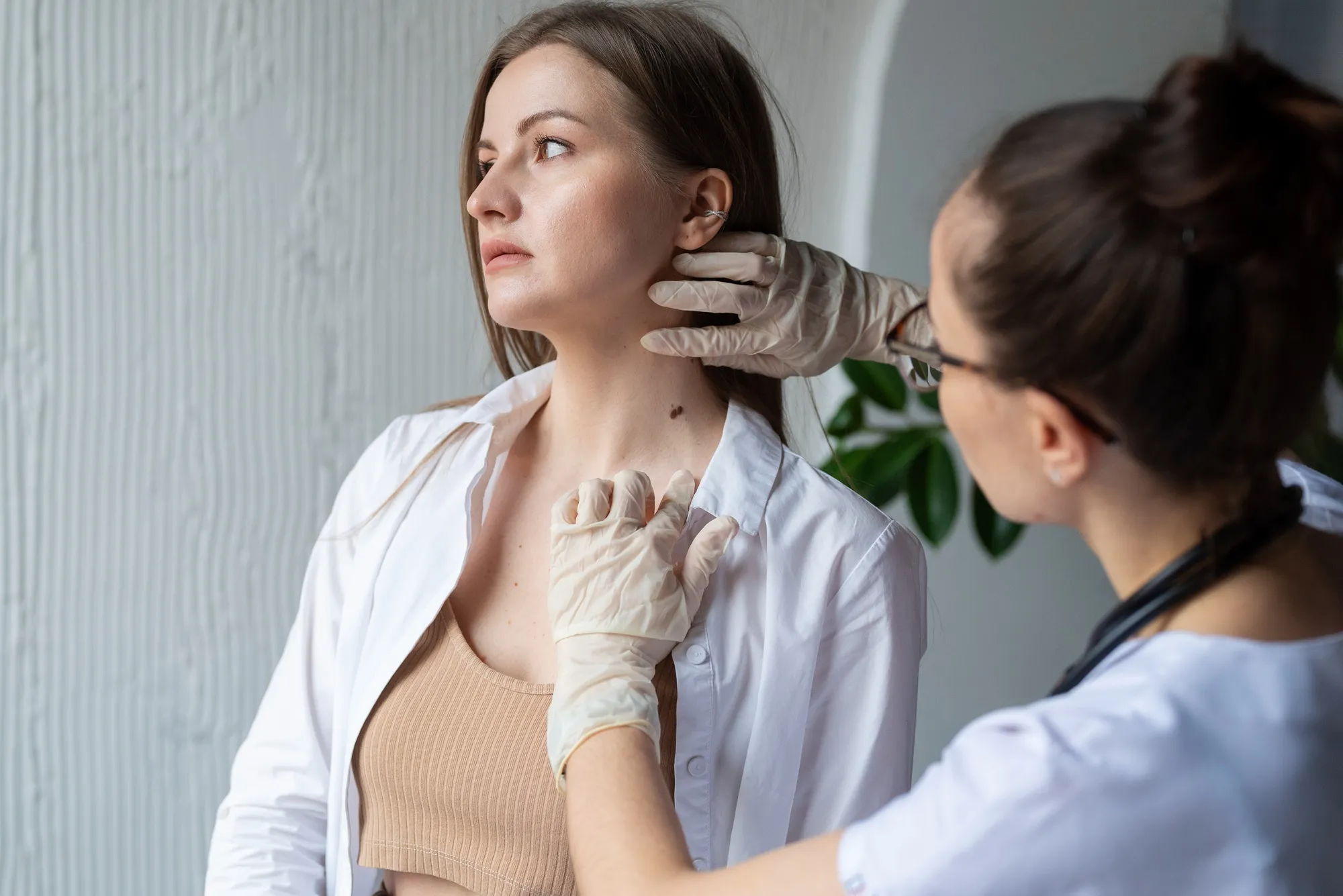
Most people have moles, and most are completely harmless. But some moles can change over time and in some cases be early signs of melanoma – the most aggressive form of skin cancer. Understanding which changes to look out for is essential, because early detection greatly increases the chances of treatment and survival.
This guide explains how to recognise suspicious moles, who is at higher risk and when you should seek professional help.
Can a mole develop into melanoma?
Yes, some moles can develop into melanoma, but it is relatively uncommon. The risk is higher in people who have many moles, a history of heavy sun damage or hereditary factors. Most common moles look the same throughout life, but atypical moles (dysplastic naevi) can behave differently.
Can a common mole become dangerous?
Common moles are usually completely benign. But sometimes the cells in the mole can start to change and become dysplastic. A dysplastic mole is not cancer, but it has a higher risk of developing into melanoma than a common mole. That is why it is important to keep an eye on your skin regularly.
How do I know if a mole is dangerous?
The most important sign is change.
A normal mole usually keeps the same:
- colour
- shape
- size
A suspicious mole or melanoma, on the other hand, may:
- grow
- get irregular edges
- change colour or have several shades
- start to itch
- start to bleed or become crusty
All such changes should be taken seriously.
When should I worry about a mole? — The ABCDE rule
Dermatologists use the ABCDE rule to identify warning signs of melanoma. It is a simple method that anyone can use at home.
A – Asymmetry
One half of the mole does not look like the other.
B – Border
The edge is uneven, blurred or irregular.
C – Colour
Several colours are visible – brown, black, red, white, blue.
D – Diameter
Larger than 6 mm (roughly the size of a pencil eraser).
Note: melanoma can sometimes be smaller.
E – Evolution
Any change in colour, shape, size, height or new symptoms such as itching or bleeding.
If you see any of these signs, you should book an appointment with a dermatologist.
Where on the body does melanoma most often appear?
Melanoma can appear anywhere, even on areas that are not exposed to the sun.
Common places:
- Women: the legs
- Men: the back
- Everyone: face, scalp, neck, chest, arms
Some areas, such as the back or scalp, are hard to see yourself, so regular check-ups are important.
Can melanoma be cured?
Yes — if it is detected early, melanoma is almost always curable.
But because melanoma grows quickly, a late diagnosis can reduce survival significantly. Early detection, skin checks and the right treatment are therefore vital.
Who is at higher risk of melanoma?
The risk of melanoma is higher in people who have:
- Fair skin, light eyes, blonde or red hair
- Freckles or sun-sensitive skin
- A family history of melanoma
- A lot of sun damage, sunburns or sunbed use
- Many moles
- A weakened immune system
- Atypical or dysplastic moles
- Live in areas with strong UV radiation
If you belong to several of these categories, you should have regular skin examinations.
What is the best treatment for suspicious moles or melanoma?
The dermatologist usually starts with a thorough skin examination and, if needed, takes a biopsy to get a reliable diagnosis.
Depending on the result, there are different treatments:
• Surgical removal
The most effective and recommended method for melanoma or high-risk moles.
• Shave excision
Mainly used for raised, benign moles where the cosmetic result is important.
• Punch excision
Suits small and deeper moles.
• Laser removal
Used only for cosmetic, non-suspicious moles.
Laser should never be used on moles that could be cancer, because the tissue then cannot be analysed.
• Advanced treatments
For advanced melanoma, immunotherapy, targeted therapy or radiotherapy may be necessary.
Can all moles be removed with laser?
No.
There are three types of moles:
- Junctional
- Dermal
- Compound
Which method is best depends on depth, size, type and appearance. Laser is only suitable for safe, benign moles.
FAQ – Frequently asked questions about moles and melanoma
How often should I check my moles?
Every 1–3 months at home, and at least once a year with a dermatologist.
Is it normal to get new moles as an adult?
It can be normal, but moles that appear after the age of 30 should be watched extra carefully.
Does sunscreen protect against melanoma?
Yes, it reduces the risk significantly — but it does not replace regular skin checks.
Does melanoma always start in a mole?
No, many melanomas start as completely new spots.
Can melanoma appear under the nails or on the feet?
Yes, even under the nails, between the toes and on the soles of the feet.
Does itching mean it is cancer?
Not always — but a mole that starts to itch should be checked.
When should I see a dermatologist?
With any change, new suspicious spots or if something looks different from your other moles ("the ugly duckling sign").