
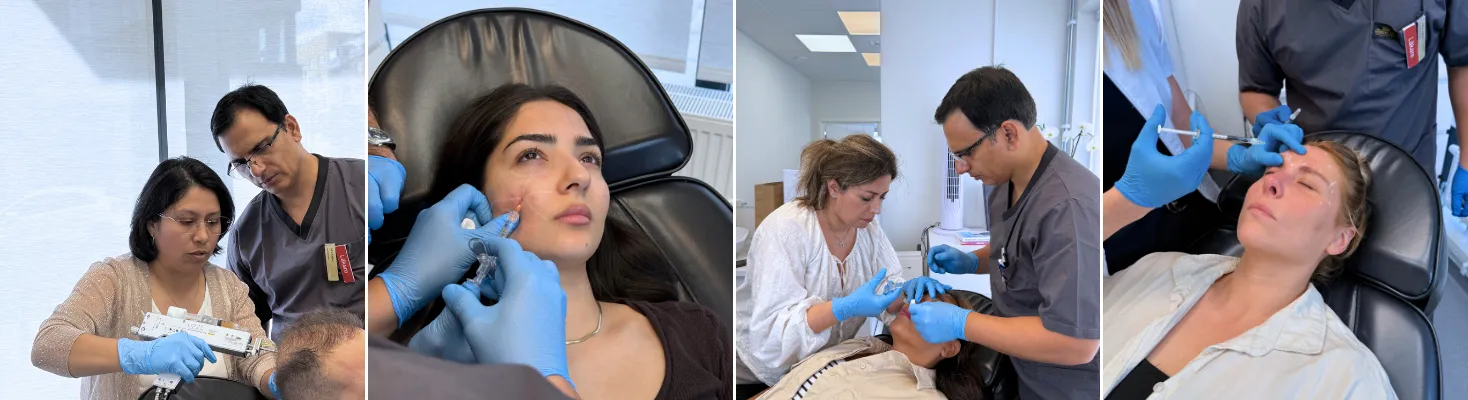
Choosing an aesthetics course is an important decision. There are many courses in aesthetic treatments, but course content, practical training and support after the course can differ significantly.
If your goal is to develop your knowledge, specialise in aesthetic medicine or build a career in aesthetic treatments, it is therefore wise to look at more than just the price and length of the course.
Here are 7 things to check before you book your aesthetics course.
1. What does the course actually include?
Start by reading the course content carefully.
A good course should give you more than a short introduction to the treatment itself. Check whether the course covers relevant areas such as:
- Facial anatomy
- The structure and function of the skin
- Indications and contraindications
- Treatment technique
- Product knowledge
- Risks and complications
- Aftercare
A clear and well-developed course programme makes it easier to understand what you will actually take away from the course.
2. How much practical training do you get?
Theory is important, but aesthetic treatments also require practical experience.
So check how much of the course consists of practical training. Do you get the chance to observe treatments, practise the technique yourself and get direct guidance from an experienced trainer?
Practical elements can give a deeper understanding of technique, anatomy and treatment planning than a course that mainly consists of theory.
3. Who is training you?
The trainer's expertise matters a lot.
Find out what medical and aesthetic experience the trainer has and whether the course is led by people with a relevant clinical background.
In aesthetic medicine, it is especially valuable if the course is based on up-to-date medical knowledge, anatomical understanding and clinical experience.
4. How does the course approach safety?
This is a point you should not compromise on.
Aesthetic treatments, especially injection treatments, require knowledge of both risks and complication management. So check whether the course covers:
- Safe treatment technique
- Contraindications
- Risk assessment
- Preventing complications
- Managing complications
- Hygiene and safety
A serious course should not only focus on how a treatment is performed, but also on when the treatment should not be performed and how risks are managed.
5. Do you get a certificate?
Find out what kind of certificate or diploma you get after the course and what it actually means.
Also check whether the course includes CPD points, if that is relevant to your profession and continued professional development.
It is important to distinguish between a course certificate and a formal qualification. A certificate from a private training provider does not automatically mean you are legally entitled to perform all aesthetic treatments.
6. Is there support after the course?
A good course does not have to end when the course day is over.
Ask whether you get support after the course, for example guidance on treatment technique, product choice or clinical questions.
This can be especially valuable when you start using your new knowledge in practice.
7. Is the course adapted to your level and goals?
Not everyone needs the same course.
A beginner may need a basic course in anatomy, skin and treatment technique, while an experienced practitioner may be more interested in advanced techniques and specific treatment areas.
So think about:
What do I want to be able to do after the course?
This helps you choose between, for example, a foundation course, advanced course, masterclass or specialised aesthetics course.
What makes a good aesthetics course?
The best course is not necessarily the longest or the cheapest. What matters is what you actually learn and how well the course prepares you for practical work.
Before you book, compare the course content, practical training, the trainers' expertise, safety routines, certification and support after the course.
Above all, you should choose a course where knowledge, practical training and safety go hand in hand.
Aesthetics courses at Nordic Skin Academy
At Nordic Skin Academy, the focus is on training in aesthetic medicine with a combination of theoretical knowledge and practical training. The courses cover different levels and treatment areas, making it possible to choose a course based on previous experience and professional goals.
The courses can focus on anatomy, injection technique, Botox, fillers, facial balancing and advanced aesthetic treatments, among other things. Practical elements give participants the opportunity to develop their technical skills under guidance.
If you want to develop in aesthetic medicine, it can therefore be worth comparing not only the course content but also how the course actually teaches the treatment and prepares you for clinical work.