
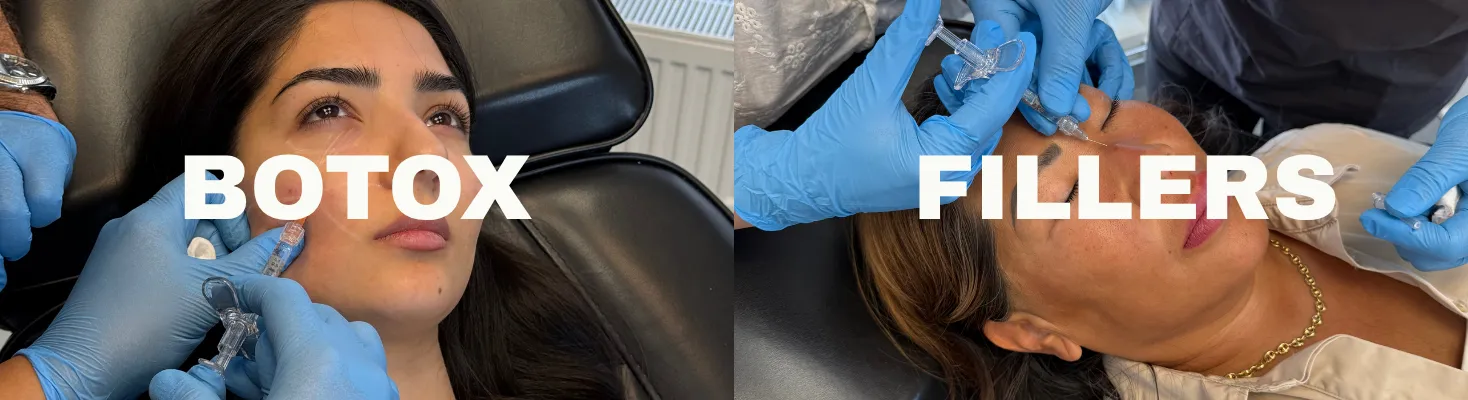
If you want to start working with aesthetic injection treatments, one of the first questions is often: should I start with Botox or fillers?
Both areas require knowledge of facial anatomy, consultation, injection technique and safety. At the same time, the treatments work in different ways and require different practical skills.
So which training is right as a first step?
What do you learn on a Botox course?
A Botox course focuses on botulinum toxin and how it is used to temporarily affect selected muscles.
A foundation course can include, among other things:
- Facial anatomy
- Indications and contraindications
- Consultation and treatment planning
- Injection technique
- Dosing and treatment areas
- Preventing complications
- Managing complications
- Practical training on models
Which areas are included varies between courses. That is why it is important to check the actual course content and how much practical training is included before you book.
What do you learn on a filler course?
A filler course focuses on dermal fillers and how volume, proportions and facial contours can be treated.
Depending on the course, the content can include, for example:
- Facial anatomy and danger zones
- Product knowledge
- Consultation and facial analysis
- Injection technique
- Different treatment areas
- Indications and contraindications
- Preventing and managing complications
- Practical training on models
Fillers also require you to develop a good aesthetic eye for proportions and how different areas of the face affect each other.
Botox or fillers – which is right as a first course?
There is no universally right answer.
Botox can be a natural first step if you are mainly interested in muscle-related wrinkles and want to build a foundation in botulinum toxin.
Fillers may suit you if you are mainly interested in face shape, volume, lips and contouring.
But it is also important to remember that the two areas complement each other. An injector who wants to work more broadly in aesthetic medicine often needs knowledge of both botulinum toxin and fillers.
A combined foundation can be an option
For those who are completely new to aesthetic injection treatments, a course covering both botulinum toxin and dermal fillers can be an option.
At Nordic Skin Academy, there is a foundation course in botulinum toxin and dermal fillers designed for professionals in medicine and dentistry, among others. The course covers facial and skin anatomy, consultation, injection technique, complication prevention and complication management, as well as practical training on live models.
This gives a broader introduction to aesthetic injection treatments instead of starting with just one treatment area.
What matters more than whether you start with Botox or fillers?
Whichever path you choose, you should look at what the course actually contains.
A good foundation should not only be about where to place the needle. You also need to understand:
- Facial anatomy and danger zones
- Who is suitable for the treatment
- Indications and contraindications
- Product and dosing knowledge
- Safe injection technique
- How complications can be prevented and managed
- Supervised practical training
- How you can keep developing your knowledge after the course
Practical training is especially important for developing injection precision and understanding what the anatomy looks like in real treatments.
How can you build on the foundation course?
A foundation course does not have to be the end point.
At Nordic Skin Academy, knowledge can be built on through Botulinum toxin levels 1–3 and Dermal fillers levels 1–3. The Academy also offers the more comprehensive Master programme for aesthetic injectors and Elite programme for aesthetic injectors, where several levels in botulinum toxin and dermal fillers are combined with more advanced practical training.
For those looking for longer-term clinical experience, there are also programmes with a fellowship, where the training is complemented with clinical specialisation. The Master programme runs for six months, while the Elite programme runs over twelve months and also includes training in PRP, skin boosters, lipolytics and thread treatments, among other things.
So which should you start with?
If you are choosing between Botox training and filler training, you do not need to think that one choice is automatically right for everyone.
Instead, start from:
What do you want to learn first?
Are you most interested in muscle-related wrinkles or in volume and facial contour?
What experience do you already have?
A beginner may need a broader foundation before more advanced techniques are introduced.
How much practical training is included?
Theory is important, but injection technique also needs to be practised under professional supervision.
Is there a clear path forward?
A course with several levels can make it easier to broaden and deepen your knowledge step by step.
So the most important thing is not whether you choose Botox or fillers first, but that your first course gives you a well-thought-out foundation you can build on.