
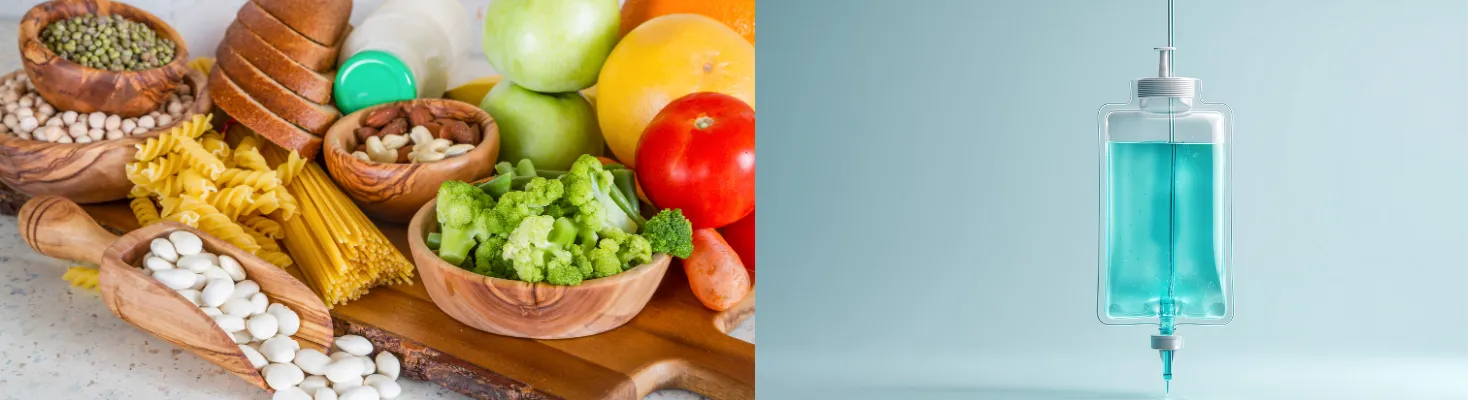
A varied and nutritious diet is the foundation of good health. Through food, the body gets the vitamins, minerals, antioxidants and other nutrients it needs to function normally every day.
But does that mean your diet always gives the same uptake of nutrients as an IV drip or vitamin drip?
The short answer is no – but that does not mean one replaces the other.
Diet and intravenous treatments serve different purposes. While food is the body's most important source of nutrition, an IV drip can in some situations be used as a complement by delivering vitamins, minerals and other nutrients directly into the bloodstream.
In this post, we go through how the body absorbs nutrition from food, how an IV drip works and why these two methods should not be seen as competitors – but as different ways of supporting the body's needs.
Diet – the foundation of good health
A balanced diet is still the best way to give the body the nutrients it needs to function optimally.
Through food, we get, among other things:
- Vitamins
- Minerals
- Protein
- Healthy fats
- Carbohydrates
- Antioxidants
- Fibre
These nutrients work together to support many of the body's normal functions, including the immune system, energy production, muscle function and cell renewal.
For most healthy people, a varied diet goes a long way towards covering the daily need for nutrition.
How does the body absorb nutrition from food?
When you eat, the body starts an advanced process in which food is first broken down in the stomach and intestines before vitamins, minerals and other nutrients can be absorbed.
How effectively the body absorbs nutrition is affected by several factors, for example:
- Digestive function
- Gut health
- Age
- Stress
- Sleep
- Lifestyle
- Certain diseases
- Certain medicines
This means the body cannot always absorb all nutrients to the same extent. How much actually becomes available varies between people.
This is usually described with the term bioavailability, which means how much of a nutrient the body can actually absorb and use.
How does an IV drip work?
Unlike nutrients from food, an IV drip is given as an intravenous infusion directly into the bloodstream.
As the nutrients do not need to pass through the stomach and intestines, they become immediately available via the blood circulation.
This is one of the biggest differences between a vitamin drip and nutritional intake through diet.
Depending on the purpose of the treatment, an IV drip can contain, for example:
- Vitamins
- Minerals
- Electrolytes
- Amino acids
- Antioxidants
- NAD+
- Glutathione
Which substances are included always depends on the content of the treatment and the client's individual needs.
Is an IV drip better than a healthy diet?
No.
An IV drip is not a replacement for a balanced diet or a healthy lifestyle.
The body still needs the wide variety of nutrients, fibre and energy that only food can provide.
Instead, intravenous treatments are often used as a complement to an already healthy lifestyle. Many people choose a vitamin drip or nutrient drip, for example, to support recovery, energy or their general wellbeing.
Regular exercise, a nutritious diet, good sleep and enough fluids are still the foundation for good long-term health.
When can an IV drip be a good complement?
Needs vary from person to person.
Some people choose a nutrient drip during periods when the body is under extra strain, for example after intense training, during stressful periods or with a heavy workload.
Others use IV therapy as part of their health routine to support energy, recovery and general wellbeing.
Which treatment is most suitable always depends on individual goals, health and lifestyle. That is why a professional assessment is important before starting an intravenous treatment.
IV drips and bioavailability – what is the difference?
One of the main reasons many people choose IV vitamin treatment is its high bioavailability.
When vitamins and minerals are taken in through food or supplements, they first have to pass through the digestive system. During that process, some of the nutrients can be broken down before the body has time to absorb them, and absorption is affected by several individual factors.
With an IV drip, the nutrients are instead delivered directly into the bloodstream, so they do not have to pass through the gastrointestinal tract before becoming available to the body.
However, this does not mean an IV drip is automatically better than a healthy diet. Food contains hundreds of natural substances – including fibre, healthy fats and plant-based nutrients – that cannot be replaced by an intravenous treatment.
The best results are often achieved when a nutritious diet is combined with healthy habits and, when appropriate, complemented with professionally tailored IV treatments.
Which option suits you?
It depends entirely on your goals and your individual needs.
If your goal is good long-term health, a varied diet, regular physical activity, good sleep and enough fluids should always be the foundation.
If, on the other hand, you want to support recovery after intense training, prepare your body for a demanding period or complement an already healthy lifestyle, an IV drip can be an option to discuss with a qualified practitioner.
There is no solution that suits everyone. The best treatment is always the one based on your individual goals, your health and your circumstances.
Good health is about more than just nutrition
Nutrition is an important part of the body's wellbeing – but it is only one part of the whole.
How we feel is affected by several factors that interact every day, including:
- Good sleep
- Stress management
- Regular physical activity
- Enough fluids
- Recovery
- Healthy habits
No single treatment can replace the importance of a healthy lifestyle. However, the right treatment, combined with good habits, can help support the body's normal functions and your general wellbeing.
Conclusion
Can you get the same nutrition from your diet as from an IV drip?
Not always.
Diet and intravenous treatments work in different ways and serve different purposes. A nutritious diet is still the most important foundation for giving the body the vitamins, minerals and other nutrients it needs every day.
At the same time, a vitamin drip or nutrient drip can be a valuable complement in some situations by delivering selected nutrients directly into the bloodstream.
It is therefore not about choosing between diet or IV therapy – but about understanding how they can complement each other. For many people, the best strategy is a combination of healthy habits, a balanced diet and professionally tailored treatments based on individual needs and goals.
Frequently asked questions (FAQ)
1. Can an IV drip replace a healthy diet?
No. An IV drip is not intended to replace a nutritious diet. The body still needs the wide variety of vitamins, minerals, protein, fibre, healthy fats and other nutrients that food provides.
2. Why do some people choose an IV drip instead of supplements?
Unlike supplements, the nutrients in an IV drip are delivered directly into the bloodstream without first passing through the digestive system. Which option is most suitable depends on individual needs and should always be assessed by a qualified practitioner.
3. What can an IV drip contain?
The content varies depending on the treatment, but a vitamin drip can contain, for example, vitamins, minerals, electrolytes, amino acids, antioxidants, NAD+, glutathione or other nutrients chosen based on the client's needs.
4. Who can benefit from an IV drip?
Many people choose an IV drip during periods of intense training, a heavy workload, travel or when they want to support the body's recovery. Which treatment is suitable is always decided after an individual assessment.
5. How long does an IV treatment take?
The treatment time varies depending on the type of infusion given, but most IV drips usually take between 30 and 90 minutes.
6. Is IV therapy suitable for everyone?
Not always. Before starting treatment, a qualified practitioner should go through your health, any medical conditions, medicines and your individual circumstances to decide whether the treatment is suitable.
7. Is there scientific support for IV vitamin treatment?
Research on IV vitamin therapy continues to develop. Intravenous treatments have long been used in healthcare for specific medical conditions, while research on their use for general wellbeing is still ongoing. Any effects can vary depending on the individual, the content of the treatment and its purpose.